A good dumpling does not ask for much. It asks for a bit of care, a steady hand, and enough patience to avoid burning your mouth on the first bite. Across dim sum and broader Asian dining, wrappers, fillings, and cooking methods vary for a reason, so the best way to eat one dumpling is not always the best way to eat the next. So, if you are not sure how to eat dumplings, read on.
Quick answer: How to eat dumplings properly
- Lift the dumpling gently so the wrapper stays intact.
- Let steam escape before taking a full bite.
- Use dipping sauce lightly so the filling still leads.
- Match your approach to the style of dumpling.
- Eat neatly, but do not overthink it. Good dumpling etiquette is practical, not fussy.
Why dumpling etiquette matters
Dumplings are built around balance.
- The wrapper should hold, not tear.
- The filling should stay juicy, not spill onto the plate.
- Sauce should support the bite, not bury it.
Once you look at it that way, etiquette starts to make sense. It protects the texture the cook intended and stops the common mistakes that flatten the whole experience. This matters even more with steamed dumplings, where the wrapper is softer and the heat stays trapped for longer.
Siu mai and har gow, for instance, are both dim sum staples, yet they behave very differently in the hand and on the palate. Har gow is known for its translucent wrapper and shrimp filling, while siu mai is usually an open-topped dumpling with pork and prawn.
How to eat dumplings without ruining them
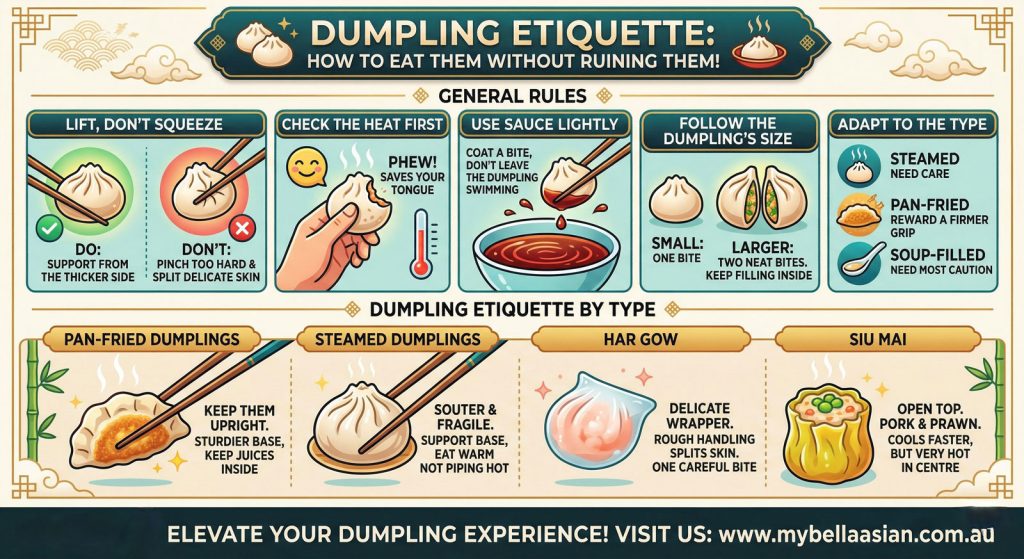
- Lift, do not squeeze. Chopsticks should support the dumpling from the base or the thicker side of the wrapper. Pinching too hard is the fastest way to split a delicate skin.
- Check the heat first. Steamed dumplings often hold far more heat than they appear to. A small first bite lets steam out and saves your tongue.
- Use sauce with a light hand. A soy-vinegar style sauce works because it adds salt, acidity, and a little depth. It should coat a bite, not leave the dumpling swimming. Good sauce balance usually relies on soy for salt and rice vinegar for sharpness, sometimes with chilli or a touch of sweetness.
- Follow the dumpling’s size. Small dumplings can be eaten in one bite if they are not dangerously hot. Larger ones are better in two neat bites so the filling stays where it belongs.
- Do not treat every dumpling the same. Pan-fried dumplings reward a firmer grip; steamed dumplings need more care; soup-filled dumplings need the most caution of all.
Dumpling etiquette by dumpling type
Different forms call for different habits.
1. Pan-fried dumplings
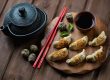
These usually have a sturdier base and a crisp side. Pick them up from the thicker edge and keep them upright so any juices stay inside.
2. Steamed dumplings
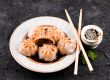
These are softer and more fragile. Support the base, pause for a second, and eat while warm rather than piping hot.
3. Har gow
Har gow is a classic Cantonese shrimp dumpling with a thin, translucent wrapper. Because the skin is delicate, rough handling will split it. One careful bite is often enough to judge the heat before finishing the rest.
4. Siu mai
Siu mai is commonly made with pork and prawn and has an open top. The exposed filling means it cools a little faster than a sealed dumpling, but it can still be very hot in the centre. That is worth remembering when ordering open-topped scallop dumplings or other open-faced styles.
Common mistakes people make
Most dumpling mishaps are avoidable:
- Drowning the dumpling in sauce
- Biting too quickly into a hot centre
- Gripping too tightly with chopsticks
- Tearing a delicate wrapper and losing the juices
- Assuming all dumplings should be eaten in one bite
The simplest test is this: if the wrapper stays intact and the filling still tastes distinct, you are doing it properly.
Where to enjoy dumplings properly in Bella Vista
Handcrafted dumplings are best eaten fresh from the steamer or pan, not after sitting around.
My Bella Asian serves steamed dumplings with handmade scallops, pork and chive on, and the restaurant is open for sunday lunch in Bella Vista from 12:00 pm to 8:30 pm.
Also Read: The $14 Dumpling Plate at My Bella Asian That’ll Steal Your Sunday Lunch Plans
Frequently Asked Questions:
1. What is the proper way to eat an open-topped dumpling?
Pick it up gently from the wrapper rather than the filling. Open-topped dumplings are exposed at the centre, so they can lose shape if squeezed. Take a measured first bite to release heat, then finish it neatly with a little sauce if needed.
2. Do you eat Siu Mai in one bite?
Often, yes, if it is small enough and has cooled slightly. Siu mai is usually compact, but size varies. If it is large or very hot, two bites is the better option. The aim is control, not bravado.
3. What is the difference between Har Gow and Siu Mai?
Har gow is typically a shrimp dumpling with a translucent wrapper. Siu mai is generally an open-topped dumpling made with pork and prawn. The wrappers, fillings, and texture are distinct, so they should not be approached in exactly the same way.
4. How to use dumpling dipping sauce correctly?
Dip lightly or spoon on a small amount. A balanced sauce usually combines soy and vinegar, sometimes with chilli or sweetness. The dumpling should still taste like a dumpling, not just sauce.
5. Should you wait before eating a steamed dumpling?
Yes. Even a brief pause helps steam settle and reduces the risk of a split wrapper or burnt mouth. A dumpling eaten too fast is usually wasted on discomfort rather than flavour.