Quick answer
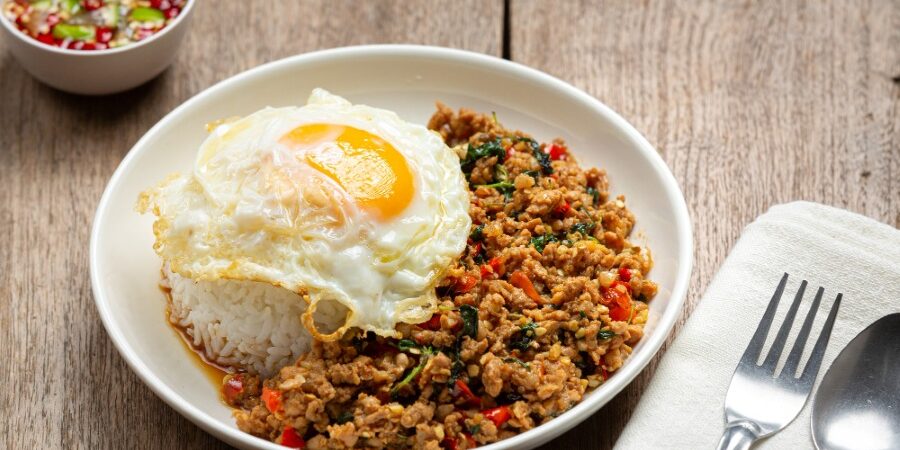
Nasi goreng is Indonesian-style fried rice, also eaten across Malaysia, Singapore and Brunei. Cooked rice is stir-fried with a paste of shallots, garlic, chilli and shrimp paste, then seasoned with kecap manis, a thick sweet soy sauce. That gives it a darker colour and a smoky, sweet-savoury taste that regular fried rice doesn’t have. It usually comes with a fried egg, pickles and prawn crackers.
What is nasi goreng?
Nasi goreng is a Southeast Asian fried rice dish, most closely tied to Indonesia and just as common in Malaysia, Singapore and Brunei. It’s usually made with cooked rice, a pounded spice paste called bumbu, kecap manis and a protein such as chicken, prawns or egg. There’s no single fixed recipe, so every cook and region has its own version.
What does nasi goreng mean?
In Indonesian and Malay, nasi means cooked rice and goreng means fried, so the name translates literally to “fried rice”. The same word turns up in other dishes, such as ayam goreng (fried chicken) and pisang goreng (fried banana).
How do you pronounce nasi goreng?
Most English speakers say NAH-see go-RENG. The “g” in goreng is hard, as in “go”, and the “ng” at the end sounds like the end of “sing”.
Where does nasi goreng come from?
Nasi goreng grew out of Chinese fried rice. Fried rice is usually traced to Yangzhou in China around the Sui dynasty (589–618 CE), as a way to use up leftover rice. Hokkien, Cantonese, Hakka and Teochew settlers carried the wok and the habit to ports across Southeast Asia.
Local cooks adapted it with shallots, chilli, shrimp paste and kecap manis. That sweet soy sauce, made with palm sugar, was developed in Indonesia and gives most versions their colour and sweetness.
The Chinese link isn’t the only theory. Fadly Rahman of Padjadjaran University has pointed to Middle Eastern pilaf as another influence. It shows in Jakarta’s goat fried rice, cooked with ghee and heavy spices.
When was nasi goreng invented?
No one can date it exactly. Chinese trade with the archipelago grew from around the 10th century, and fried rice most likely arrived with the settlers who followed. The earliest local mention is in Serat Centhini, an early 19th-century Javanese text, which calls it sekul goreng.
That early version used no soy sauce and was eaten with side dishes, closer to today’s savoury Sundanese style than the sweeter Javanese one. By the late 1800s, recipes were appearing in Dutch colonial cookbooks. Colonial migration then carried it to Suriname, Sri Lanka and the Netherlands, where it’s still everyday takeaway.
Is nasi goreng Indonesian or Malaysian?
Both. It’s most closely tied to Indonesia, where it’s an official national dish, and Malaysia lists it as part of its national culinary heritage. It’s also a household staple in Singapore, Brunei and the Malay-speaking south of Thailand.
Is nasi goreng Indonesia’s national dish?
Yes, it’s one of five. In September 2018, Indonesia’s Tourism Ministry named soto, rendang, nasi goreng, satay and gado-gado as national dishes. Before that, it had been treated as an unofficial national dish for decades.
It has a place in Indonesian history too. On 17 August 1945, nasi goreng was the pre-dawn Ramadan meal as Sukarno, Mohammad Hatta and Ahmad Soebardjo drafted the independence proclamation.
What is nasi goreng made of?
A typical plate is built from five things:
- Cooked rice, ideally a day old
- Bumbu, a paste of shallots, garlic, chilli and shrimp paste
- Kecap manis, often with a pinch of salt or a splash of light soy
- A protein such as chicken, prawns, beef or just egg
- Toppings such as a fried egg, fried shallots, pickles and prawn crackers
What is the sauce in nasi goreng?
The main sauce is kecap manis, a thick, syrupy soy sauce sweetened with palm sugar. It gives nasi goreng its brown colour and caramelised flavour. Some cooks also add sambal, oyster sauce, fish sauce or a little tamarind.
Not every version uses kecap manis. Makassar’s red nasi goreng swaps it for tomato and chilli sauce, and Balinese and salted fish versions usually leave it out.
What is nasi goreng paste?
Nasi goreng paste is the bumbu, ground and fried in oil before the rice goes in. The shrimp paste in it, called terasi in Indonesia and belacan in Malaysia, gives the dish its deep savoury base. Javanese versions can include candlenut, and Sundanese ones add turmeric.
Supermarkets sell ready-made jars and sachets. They work, but a fresh paste tastes brighter and less salty.
Why is nasi goreng made with day-old rice?
Rice that has sat in the fridge overnight is drier and firmer than fresh rice, so the grains stay separate and fry rather than steam. Fresh rice holds too much moisture, so it clumps and turns soft.
If you cook rice specially, spread it on a tray to cool, then refrigerate it promptly. Cooked rice left at room temperature for hours isn’t safe to eat.
What toppings go on nasi goreng?
The classic topping is a fried egg with a runny yolk, called telur mata sapi (“cow’s eye egg”) in Indonesia. Around it you’ll usually find:
- Bawang goreng (fried shallots) for crunch
- Kerupuk, usually prawn crackers or emping (melinjo nut crackers)
- Acar, quick pickles of cucumber, carrot, shallot and chilli
- Fresh cucumber and tomato slices to cut the richness
- Sambal on the side for extra heat
What does nasi goreng taste like?
Nasi goreng tastes sweet, salty and smoky, with a savoury depth underneath. The sweetness comes from kecap manis caramelising against a hot wok. Shrimp paste adds a rich, almost meaty note, and fried shallots bring a toasty crunch.
A well-cooked plate also carries a light char from the wok. The pickles and fresh cucumber on the side stop each mouthful from feeling heavy.
Is nasi goreng spicy?
It’s usually mild to medium, though a little spicier than Chinese-style fried rice. The chilli in the paste adds warmth more than real heat, and most of the fire comes from sambal on the side.
In Indonesia, street cooks often ask how hot you want it, from mild to extra hot. Some versions are built for heat, like nasi goreng setan (“devil’s fried rice”), made with several kinds of chilli. If you’re sensitive to spice, ask for it mild and leave the sambal alone.
Nasi goreng vs fried rice: what’s the difference?
The main difference is the seasoning. Nasi goreng is fried with a spice paste and sweet soy sauce, so it’s darker, sweeter and more aromatic. Chinese-style fried rice, the special fried rice most Australians know, is seasoned lightly and tastes cleaner.
| Nasi goreng | Chinese-style fried rice | |
| Flavour base | Paste of shallot, garlic, chilli and shrimp paste | Garlic and spring onion |
| Main seasoning | Kecap manis (sweet soy sauce) | Salt, light soy, sometimes oyster sauce |
| Colour | Dark caramel-brown | Pale gold |
| Taste | Sweet, smoky, savoury, gently spicy | Savoury, mild, egg-forward |
| Egg | Usually fried and served on top | Usually scrambled through the rice |
| How it’s eaten | A meal on its own, with pickles, crackers and sambal | Often a side to other dishes |
Is nasi goreng the same as fried rice?
In name, yes. Indonesians call any fried rice nasi goreng, and refer to the Chinese style as nasi goreng China or nasi goreng Hongkong. Outside Indonesia, though, nasi goreng means the Indonesian style made with spice paste and kecap manis.
Is nasi goreng Thai?
Not originally. Nasi goreng is Indonesian and Malay, though it’s also eaten in Thailand’s Malay-speaking southern provinces of Pattani, Yala and Narathiwat.
Thailand’s own fried rice, khao pad, is seasoned with fish sauce and served with lime and cucumber, with no kecap manis. To add to the confusion, Indonesians call pineapple fried rice “nasi goreng Thailand”.
What are the different types of nasi goreng?
There are dozens. Dwi Larasatie, a culinary expert at Gadjah Mada University, counts 104 types across Indonesia, 20 of them on Java alone. Most are named after their main ingredient or home region. These are the ones you’re most likely to come across:
| Type | Where it’s from | What makes it different |
| Nasi goreng ayam | Indonesia, Malaysia | Chicken; one of the most common versions |
| Nasi goreng udang / seafood | Across the region | Prawns, squid or mixed seafood |
| Nasi goreng spesial | Indonesia | The loaded version: chicken, egg, often sausage, topped with a fried egg |
| Nasi goreng kampung | Malaysia | “Village-style”, with dried anchovies and water spinach |
| Nasi goreng pattaya | Malaysia | Fried rice wrapped in a thin omelette, served with chilli or tomato sauce |
| Nasi goreng mamak | Malaysia, Singapore | Indian Muslim style, seasoned with curry spices |
| Nasi goreng USA | Malaysia | Prawns, squid and chicken; the letters stand for udang, sotong, ayam |
| Nasi goreng kambing | Jakarta | Goat or mutton, heavy spices and ghee; famous in the Kebon Sirih area |
| Nasi goreng merah | Makassar, South Sulawesi | Red from tomato and chilli sauce, used instead of kecap manis |
| Nasi goreng ikan asin | Indonesia, Malaysia, Brunei | Salted fish, usually with little or no kecap manis |
| Nasi goreng Bali | Bali | Lemongrass, turmeric and galangal, and no soy sauce |
| Nasi goreng tek-tek | Indonesian street carts | Named after the “tek-tek” sound vendors make tapping the wok to announce the cart |
How is nasi goreng made?
You fry a spice paste, cook the protein, then toss in cold rice and kecap manis over high heat. Once everything is chopped, the cooking takes about 10 minutes.
Nasi goreng ingredients (serves 2)
- 3 cups cooked jasmine rice, cold from the fridge
- 4 red Asian shallots, or half a brown onion
- 2 garlic cloves
- 1 to 2 long red chillies (add a bird’s eye chilli for more heat)
- 1 tsp shrimp paste (terasi or belacan)
- 2 tbsp vegetable oil
- 200 g chicken thigh, thinly sliced, or peeled prawns
- 2 tbsp kecap manis
- 1 tsp light soy sauce
- 2 eggs
- To serve: fried shallots, cucumber, tomato, prawn crackers and sambal
Method
- Make the paste. Toast the shrimp paste in a dry pan for about a minute to mellow its smell. Pound or blitz it with the shallots, garlic and chilli into a rough paste.
- Fry the paste. Heat 1½ tbsp oil in a wok over medium-high heat. Fry the paste for 2 to 3 minutes, until it darkens and smells sweet rather than raw.
- Cook the protein. Add the chicken and stir-fry for about 3 minutes, until just cooked. Prawns need 1 to 2 minutes.
- Add the rice. Turn the heat to high. Add the rice, break up any clumps with the back of the spatula, and toss until every grain is coated and hot.
- Season. Pour the kecap manis and soy around the edge of the wok so they sizzle and caramelise, then toss through. Taste, and add more of either if needed.
- Fry the eggs. In a separate pan, fry the eggs in the remaining oil until the edges are crisp and the yolks are still runny.
- Serve. Plate the rice, top with the eggs and fried shallots, and put the cucumber, tomato, crackers and sambal on the side.
Don’t crowd the wok. For more than two serves, cook in batches so the rice fries instead of steaming.
What rice is best for nasi goreng?
Long-grain rice such as jasmine works best. It dries out well overnight, so the grains stay separate in the wok. Medium- and short-grain rice are stickier and tend to clump, and basmati works in a pinch.
What do you serve with nasi goreng?
Nasi goreng is a full meal on its own, so the sides are there for contrast. The classic pairing is satay: grilled chicken skewers with peanut sauce. Other good matches:
- Acar or sliced cucumber to cut the richness
- Prawn crackers for crunch
- Sambal for heat
- Ayam goreng (Indonesian fried chicken) for a bigger meal
- Stir-fried Asian greens
To drink, iced sweet tea (es teh manis) is the everyday choice in Indonesia. A cold lager also works well with the sweet, salty flavours.
When do people eat nasi goreng?
At any time of day. Warungs serve it from morning to night, and after dark, hawkers push carts through residential streets and cook it to order.
Can you eat nasi goreng for breakfast?
Yes, it’s one of the most common breakfasts in Indonesia, Malaysia and Singapore. At home it’s made from last night’s rice and leftovers, then topped with a fried egg. If you’ve stayed in Bali, you’ve probably seen it on the hotel breakfast buffet.
Is nasi goreng healthy?
It can fit into a balanced diet, but it isn’t a light dish. It’s mostly white rice fried in oil, kecap manis adds sugar, and soy and shrimp paste make it fairly salty. The egg and the chicken or prawns do add a decent amount of protein.
For a lighter plate, ask for extra vegetables and go easy on the prawn crackers. At home you can cut back the oil or use brown rice, though the texture changes.
Is nasi goreng gluten free?
Not usually. Rice is gluten free, but most kecap manis and soy sauce brands are brewed with wheat. A gluten-free version is possible with gluten-free kecap manis or tamari. If you’re coeliac, always ask the kitchen, because shared woks and sauces can carry traces.
Is nasi goreng vegetarian?
Traditional nasi goreng isn’t. The paste usually contains shrimp paste, and some cooks add fish sauce. Vegetarian versions leave these out and use vegetables, tofu or egg instead. Vegans should also skip the egg and the prawn crackers.
How is nasi goreng different from nasi lemak, mie goreng and nasi campur?
All four come from the same part of the world, but only nasi goreng is fried rice.
Nasi goreng vs nasi lemak
Nasi lemak is rice cooked in coconut milk with pandan leaf, not fried. It comes with sambal, fried anchovies, roasted peanuts, cucumber and egg, and is widely seen as Malaysia’s national dish. Nasi goreng is darker and drier, and the seasoning is cooked into the rice.
Mie goreng vs nasi goreng
Mie goreng (also spelt mee or mi goreng) is the noodle version. It uses similar seasoning, with sweet soy, garlic, shallot and chilli, but swaps rice for egg noodles. Most Australians know the name from Indomie Mi Goreng instant noodles.
Nasi goreng vs nasi campur
Nasi campur means “mixed rice”. It’s a plate of steamed rice with small portions of several dishes around it, such as meat, vegetables, egg and sambal. Nothing is fried together, while nasi goreng is one dish cooked in a single wok.
Where can you get nasi goreng in Bella Vista?
At My Bella Asian, 7–9 Irvine Place, Bella Vista. Our nasi goreng is smoky, wok-fried Indonesian rice with king prawns, chicken thigh and house-pickled acar. We also make a vegetarian nasi goreng with vegetables and acar, which can be prepared gluten free on request.
Order it the Indonesian way, with Sate Ayam (grilled chicken skewers with Java peanut sauce), prawn crackers and a side of Sambal Merah. That puts two of Indonesia’s five national dishes on your table. Add the Beef Cheek Rendang, slow-braised for 18 hours, and you have three.
Nasi goreng is also on our set menu for two to four people. Our kitchen handles gluten, nuts, shellfish and sesame, so let us know about any allergies when you order.
Book a table, order takeaway online or call (02) 8824 4801.